
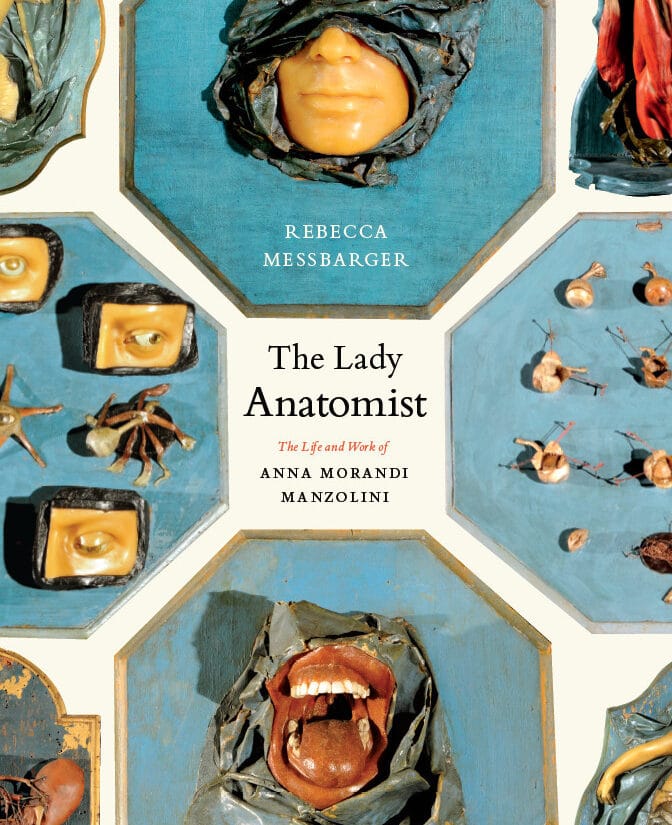
Rebecca Messbarger’s The Lady Anatomist: The Life and Work of Anna Morandi Manzolini tells the story of Anna Morandi Manzolini, an eighteenth-century wax modeler, anatomist, teacher, and scholar from Bologna, Italy. The book explores not only Morandi’s remarkable life, but also the scientific, cultural, and political world that made her work possible.
Morandi was born in 1714 and later married Giovanni Manzolini, an artist and anatomist. Together, they worked on anatomical wax models, first through a papal commission connected to the University of Bologna’s Anatomy Museum, and later through their own home laboratory. Over time, Morandi and her husband gained access to more than a thousand unclaimed bodies from public hospitals in Bologna, allowing them to conduct dissections and create highly accurate anatomical models.
What makes Morandi’s story so fascinating is that she was far more than an assistant or craftswoman. Messbarger makes a strong case that Morandi was an innovative scientist in her own right. She studied human anatomy closely, taught publicly, engaged in scientific debates, and used her own observations from dissections to support her conclusions. Her areas of expertise included skeletal development, male and female reproductive anatomy, and the sensory organs.
The book also highlights how Morandi’s view of the human body challenged the thinking of her time. Her realistic and analytical study of male and female anatomy stood in contrast to common eighteenth-century ideas about female inferiority. Even though she held a position as a public lecturer at the University of Bologna, many of her colleagues continued to view her more as an artist than as a scientist. This may be one reason her contributions faded into relative obscurity after her death.
Messbarger’s work is more than a biography. It paints a detailed picture of eighteenth-century Bologna and the broader Enlightenment period. Through archival research, letters, notebooks, and contemporary accounts, the book shows how Morandi’s achievements were connected to a larger network of scholars, artists, religious leaders, and scientific institutions. It also reveals surprising details, including Pope Benedict XIV’s interest in anatomy and the relatively high status of women scientists in Bologna during that period.
One of the most interesting parts of the book is its discussion of anatomical wax models. Morandi and Manzolini helped shift the purpose of wax modeling from artistic study to scientific education. Their models were not simply beautiful objects. They were teaching tools designed to help students understand the body more accurately. In that sense, their work has similarities to modern anatomical teaching methods that use preserved or plastinated specimens.
The Lady Anatomist is described as fascinating and enlightening, though not always an easy read. Its language can be dense at times, but the depth of research and the richness of the subject make it worthwhile. Readers interested in women’s history, medical history, anatomy, art, science, or the Enlightenment will find plenty to appreciate.
Overall, Rebecca Messbarger’s The Lady Anatomist brings long-overdue attention to Anna Morandi Manzolini, a woman whose scientific talent and teaching helped shape the history of anatomy. It is a powerful reminder that important contributors to science have often been overlooked, especially women whose work was misunderstood, minimized, or credited through the lens of art rather than scholarship.
Book Details:
The Lady Anatomist: The Life and Work of Anna Morandi Manzolini
Rebecca Messbarger
The University of Chicago Press, 2010
248 pages
ISBN: 978-0-226-52081-0
Review Author:
Sabine Hildebrandt, MD, FAAA
